
Multilingual PDF Accessibility
When a blind reader opens a PDF and has it read aloud, most documents either say nothing at all or come out with the sentences jumbled. The cause is not how the page looks — it is the invisible structure underneath it. I repair that structure. The layout is preserved — any slight rendering differences are measured and stated in the report.
In short
What I do
- Take your existing PDF and repair its structure while preserving the layout, measuring any minor rendering differences.
- Prepare the structure for use with a screen reader (software that reads text aloud) and verify it technically: headings become navigable, images described, reading order defined.
- Hand back every file with a verifier report covering the PDF/UA requirements that PAC checks, plus a report on the points I checked by hand.
- Work in Arabic, Chinese, Spanish and other languages — including right-to-left scripts.
Not part of this service
- Translation. You or your translator supply the wording; I do not touch it. Placing a translation into the layout is a separate job, and I do that too.
- The document’s content, prices and design. Remediation does not touch the wording, the prices or the design. If you also need the content or the layout changed, that is a separate job and I do that too.
- Usability testing with disabled users. That is a separate discipline; my findings come from the file’s structure and from a verifier.
- Legal advice. I tell you what needs doing to a document; whether and how a regulation applies to your organisation belongs with your own legal counsel.
- The accessibility of your website itself. This page is about documents; the site is a different matter.
Is this page for you?
You are in the right place if one of these is your situation:
- A client or a regulator has asked for your documents to be accessible, and nobody is quite sure what that means in practice.
- Your brochure or manual was translated into several languages and you do not know whether the translated editions are usable.
- A supplier sent you a file marked “compliant” and you want it checked independently.
- You publish in Arabic or another right-to-left language and suspect something is wrong with those editions.
Check your own document in one minute
A rough test you can run yourself: open the PDF, select a few paragraphs with the mouse, copy them, and paste into an empty text file.
- If the text arrives out of order, that points to a problem with the text extraction or with the reading order.
- If no text arrives at all, the document is probably a scanned image with no real text in it.
- If letters come out run together or reversed, the text was written into the file in the wrong order.
If all three look fine, the document may be in good shape. Headings, lists and images still have to be tagged, and that does not show up in a copy-and-paste test.
Read on for the technical detail. Below: why translated documents break, which obligations apply and to whom, what the standards require point by point, and a measured example in four languages. If you would rather skip ahead, send one document and I will tell you what is wrong with it.
A translated PDF is not an accessible PDF
A brochure comes back in six languages. The layout matches, the typography matches, the text is correct. Underneath, the part that assistive technology actually reads has been rebuilt from scratch by the layout software — and after a translation, that structure usually needs to be checked again.
The document says it is written in Hebrew
A PDF declares its language in a single catalog entry. A screen reader trusts that entry
and picks a voice from it. When a template is reused across languages, that entry is very
often left at whatever the first edition said. I have measured an Arabic file and a Chinese
file, both published by a federal agency, that declared themselves as
he — Hebrew. That incorrect language setting can seriously disrupt pronunciation and screen reader use for exactly the readers the files were translated for — and nothing on the page shows it.
Arabic text stored backwards
In right-to-left layouts the text is frequently written into the file in the order it is
painted on the page, not the order it is read. Copy it out and it comes back scrambled;
assistive technology receives it the same way.
ISO 32000-1 §14.8.2.3.3 describes reverse-order show strings and the ReversedChars marked-content tag; text stored that way needs ReversedChars or ActualText for the logical order to reach a screen reader at all. Checking tools do not test this.
A file can pass PDF/UA with every Arabic sentence stored in reverse — which is exactly why
a green result on an RTL document should not be taken at face value.
1526-793-008-1. That is why a pattern cannot catch it; the correct number has to be confirmed against the other language editions.Structure does not survive the translation round trip
Headings become ordinary paragraphs. Bulleted lists become loose lines. Image descriptions
are dropped, because the source language’s descriptions no longer apply and no one wrote new
ones. The English original may have been tagged properly; that work does not travel with the
translation.
Evidence: one poster, four languages
Rather than describe the work, here is a measured example. The U.S. Equal Employment
Opportunity Commission publishes its Know Your Rights poster in many languages.
I took four editions — English, Spanish, Arabic and Simplified Chinese — and remediated all
four. The files are works of the U.S. federal government and therefore in the public domain. The source editions are published by the EEOC; the remediated versions can be downloaded below.
What the source files contained
| Measured | English | Spanish | Arabic | Chinese |
|---|---|---|---|---|
| Declared language | en-US | en-US | he | he |
| Document title | present | present | none | none |
| Headings | 1 | 1 | 0 | 0 |
| Tagged lists | 0 | 0 | 0 | 0 |
| PDF/UA declaration | none | none | none | none |
What the verifier reports
All four files now return the same result in PAC 2026:
“The PDF/UA requirements checked by PAC are fulfilled.”
| Measured | English | Spanish | Arabic | Chinese |
|---|---|---|---|---|
| Declared language | en-US | es | ar | zh-CN |
| Headings | 15 | 15 | 15 | 15 |
| Tagged lists | 9 | 5 | 5 | 4 |
| Described links | 11 / 11 | 11 / 11 | 10 / 10 | 11 / 11 |
| Bookmarks | 15 | 15 | 15 | 15 |
| Visual difference | 0.030 % | 0.045 % | 0.185 % | 0.005 % |
Visual difference is measured by rendering every page at 120 dpi and comparing
it pixel by pixel against the source. Each scripted step measures zero difference; the figures
above come from the font re-embedding performed when the file is saved during manual tagging.
Inspected at 400 dpi, the affected pixels are edge-smoothing along glyph outlines. I report the
number rather than claiming nothing changed, because the number is not zero and anyone can
measure it.
What the verifier does not report
Two findings in that set were never going to appear in any tool, and both went into the
report that accompanies the files:
Contrast below the threshold
The contact labels are set in the organisation’s brand red on white at 9–10 pt:
4.35:1 against the 4.5:1 that WCAG 2.2 AA asks for normal text. Measured
and reported — not changed. Altering an organisation’s brand colour is a
design decision that belongs to whoever owns the design, not to the person repairing the
tags.
A phone number missing a digit
The Arabic edition prints the TTY line as 1-800-669-682. The English,
Spanish and Chinese editions all print 1-800-669-6820. In the Arabic edition, the one
group of readers that number exists for cannot reach it. Found by comparing the four
language editions against each other; reported, not silently rewritten.
The value is in finding and documenting the problems an automated check cannot assess. A green result is a floor, not the whole delivery.
Before and after — download both and compare
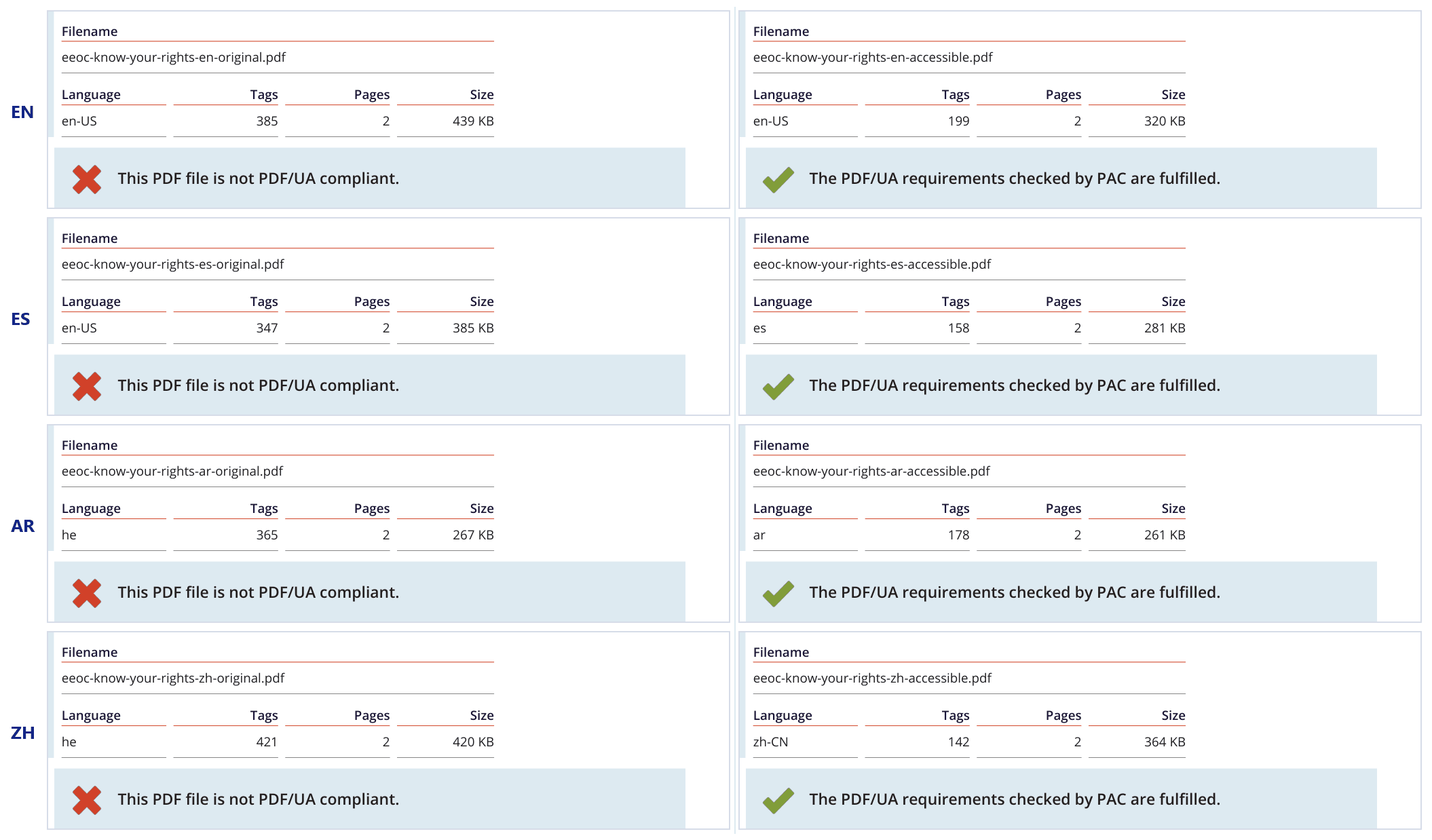
he in the source and ar and zh-CN after remediation.You do not have to take the tables above on trust. For each language, both the edition the EEOC publishes and the remediated edition are here, each with its own PAC verification report. All eight documents are PAC’s own output; I did not write a line of them.
| Language | As published by the EEOC | After remediation |
|---|---|---|
| English | download file (440 KB) PAC report: not compliant | download file (320 KB) PAC report: requirements fulfilled |
| Spanish | download file (386 KB) PAC report: not compliant | download file (281 KB) PAC report: requirements fulfilled |
| Arabic | download file (267 KB) PAC report: not compliant | download file (260 KB) PAC report: requirements fulfilled |
| Chinese | download file (420 KB) PAC report: not compliant | download file (364 KB) PAC report: requirements fulfilled |
Two lines in those reports are worth opening: in the Arabic and Chinese source reports the “Language” field reads he — Hebrew. In the same reports the document title is empty. In the remediated reports those fields read ar and zh-CN.
In the Arabic and Chinese reports the document title renders as empty boxes: PAC’s report template uses a typeface that has no glyphs for those scripts. The title is present in the file — select that line in the report and copy it to see the text.
The source files were downloaded from eeoc.gov on 22 September 2026 and the measurements refer to those editions. I keep copies of the sources here so the comparison still works if the EEOC updates its files. The files are works of the U.S. federal government and therefore in the public domain. The findings report for each file is available on request. The full report for this case study is published here.
What you receive
- The remediated PDF, with the layout preserved and the change measured, not asserted.
- A verifier report (PAC 2026) for each file.
- A findings report: what was corrected, what was found and deliberately left alone, and why.
- Correct document language, document title, heading structure, tagged lists, reading order,
image descriptions, described links and a document outline. - For right-to-left files: logical reading order restored where the text is stored visually.
- Tag tree, artifacts, table header cells and form fields: decorative elements are taken out of the reading flow, table header cells are bound to their rows and columns, form fields are given a name and a tab order.
If the layout, wording or language of the document also needs changing: PDF and catalog editing and localization.
How the work runs
- Send one document. The real one, in the language that worries you most.
I inspect it and tell you what is actually wrong with it — including the parts I would not
charge to fix. - You receive a scope and a price for the set, before anything starts.
- Payment, then work. You receive a watermarked version plus the verifier
report for checking. - Approval releases the final files. If the result is not what you needed,
your payment is refunded in full.
Languages and scripts
I work on the structure of the file, not on the wording. Arabic, Hebrew and other
right-to-left scripts, Chinese, Japanese and Korean, Greek, Cyrillic, and the Latin-script
European languages are all handled the same way: the text you supply stays exactly as your
translator wrote it, and I repair what sits underneath it.
I do not translate, and I do not edit wording in a language I cannot read.
Where a description has to be written in the document’s language — an image description, for
example — I prepare it from the document’s own text and mark it for your reviewer to confirm.
Correspondence is in English or Turkish, in writing. If the translated text also has to be set into the layout, that is a separate service I provide.
Pricing
Priced per document after I have seen it. Page count alone does not determine the work: a
thirty-page report with a consistent template can take less time than a two-page poster with
four languages, tables and a broken reading order. You get a fixed price for the set before
any work starts, not an hourly meter.
Why this matters now
The European Accessibility Act applies since 28 June 2025 to the specified products and services offered on the EU market. Whether a particular document has to meet accessibility requirements depends on the product or service it belongs to and on the role it plays in that service.
In the United States, the Department of Justice’s ADA Title II web rule was
extended in April 2026: state and local government entities serving 50,000 people or more must
comply by 26 April 2027, and smaller entities by 26 April 2028,
to WCAG 2.1 Level AA.
Organisations that publish in one language are working through this already. Organisations
that publish in six are usually discovering that the other five editions were never checked.
Frequently asked questions
Do you need the InDesign or Word source file?
No. I work on the PDF directly. If you do have the source file, say so — for some documents
it is the faster route, and I will tell you when that is the case.
Can a scanned PDF be made accessible?
Scanned PDFs can be examined as well. Whether — and how far — accessible remediation is possible depends on the quality and structure of the source file. After reviewing the PDF I will tell you what can be done.
Will the document look different afterwards?
The layout is preserved. Every page is compared against the source pixel by pixel, and the measured difference is stated in the report. Typical figures are between 0.005 % and 0.185 % of the page area, all of
it edge-smoothing along glyph outlines from font re-embedding.
My supplier already sent me a file that passes the checker.
Send it. A checking tool verifies that a description exists; it cannot judge whether the
description is useful, whether a heading level reflects the document’s structure, or whether
Arabic text is stored in reading order. Those are the three places I find problems most often
in files that already pass.
Do you test with a screen reader?
No, and I will not claim otherwise. My findings come from the file’s structure, from the PDF
specification and from a verifier. If your organisation requires testing with assistive
technology by users, that is a separate discipline and you should commission it separately.
Can you handle a set of the same document in several languages?
That is the work I am set up for. Comparing the editions against each other is also how
defects like a missing digit in one language get found.
Send me one document
One file, the language that worries you most. You will get back a straight account of what is
wrong with it, including the parts that are not worth paying to fix.
Ali Karabüyük · Tekirdağ, Türkiye · working remotely with clients worldwide ·
document and image production since 2004, professional practice since 2008.