
PDF & Catalog Editing
PDF & Catalog Editing, Translation Layout and Multilingual Adaptation
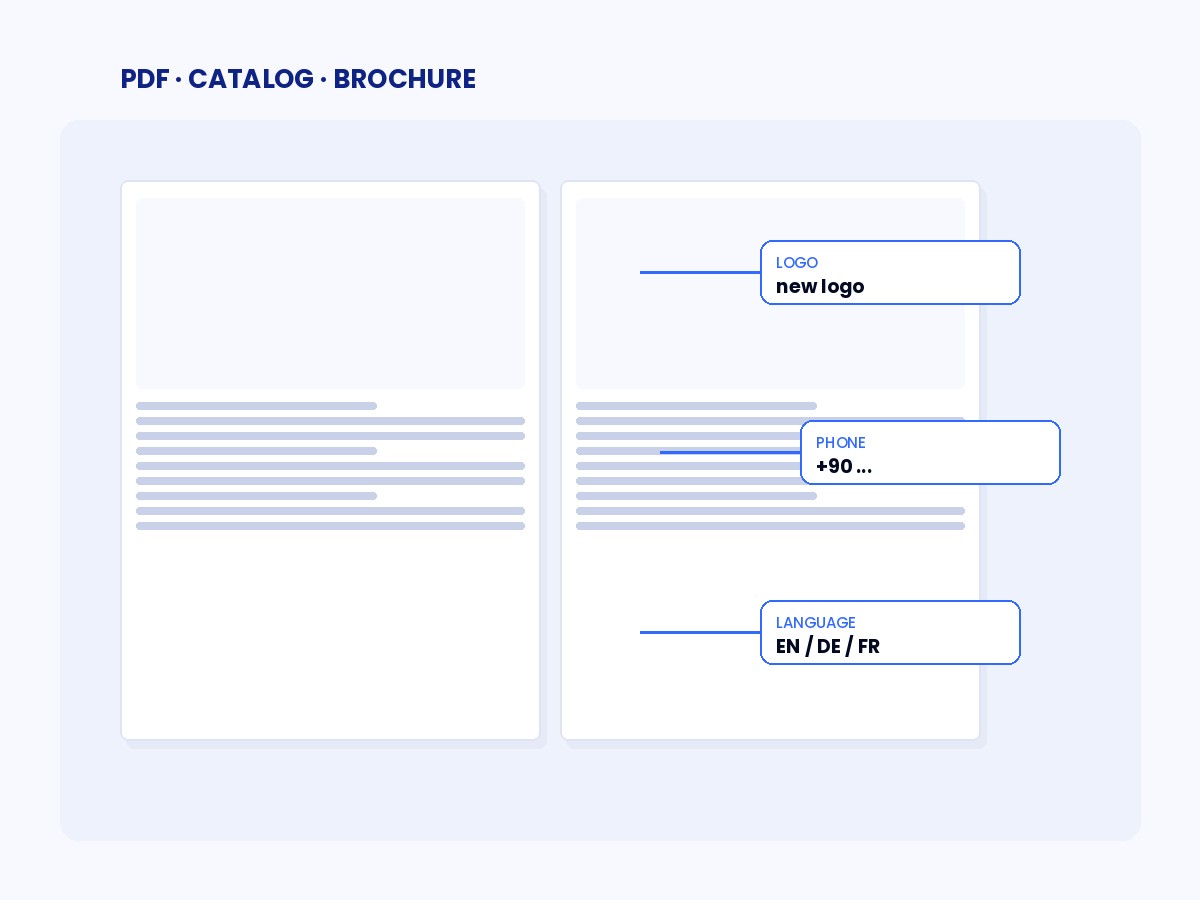
Send me your existing PDF, catalog or JPEG and I will change the text, images, company details and language while keeping the original layout intact — even when the source design file is long gone.
In graphic design since 2004
Long experience on the Photoshop and print-preparation side of the work.
No source file needed
A PDF or JPEG is enough. AI, PSD or InDesign files are not required.
Review first, then a price
I do not quote blind. Feasibility is checked before anything is agreed.
You Probably Do Not Need a Brand New Catalog
A company had its catalog designed five years ago. The layout still holds up. But the logo has changed, the phone numbers are different, several products are discontinued, and the agency that built the file is nowhere to be found.
I see this constantly.
A file like that rarely needs to be rebuilt from scratch just because a few details went stale. I work on the existing pages: rebuild the areas that need to change, remove the old text, and place the new content so it matches the visual language already on the page.
What I sell is document editing and layout work. Translation is one of the routes through that work, not the product itself. If you already have the translated copy, I place it. If you do not, AI-assisted translation is an option on suitable documents, or we can bring in a professional translator.
What Can Be Changed in a Catalog
Everything below can be changed while the existing design stays in place. You do not have to do all of it — the work can cover only the areas you actually need.
Adapting Your Catalog Into the Language You Need
This is not limited to translating a foreign catalog into one particular language. Your catalog can be adapted from its source language into whichever target language you need.
A Turkish product catalog can be adapted into English. An English catalog can go into German. A German document can be rebuilt in French, a Spanish one in English. You can take the catalog your overseas manufacturer sent you and produce a local-language edition, or take your current English catalog into a new language for a new market.
What matters is not the specific language pair. It is whether the new copy sits correctly inside the existing design.
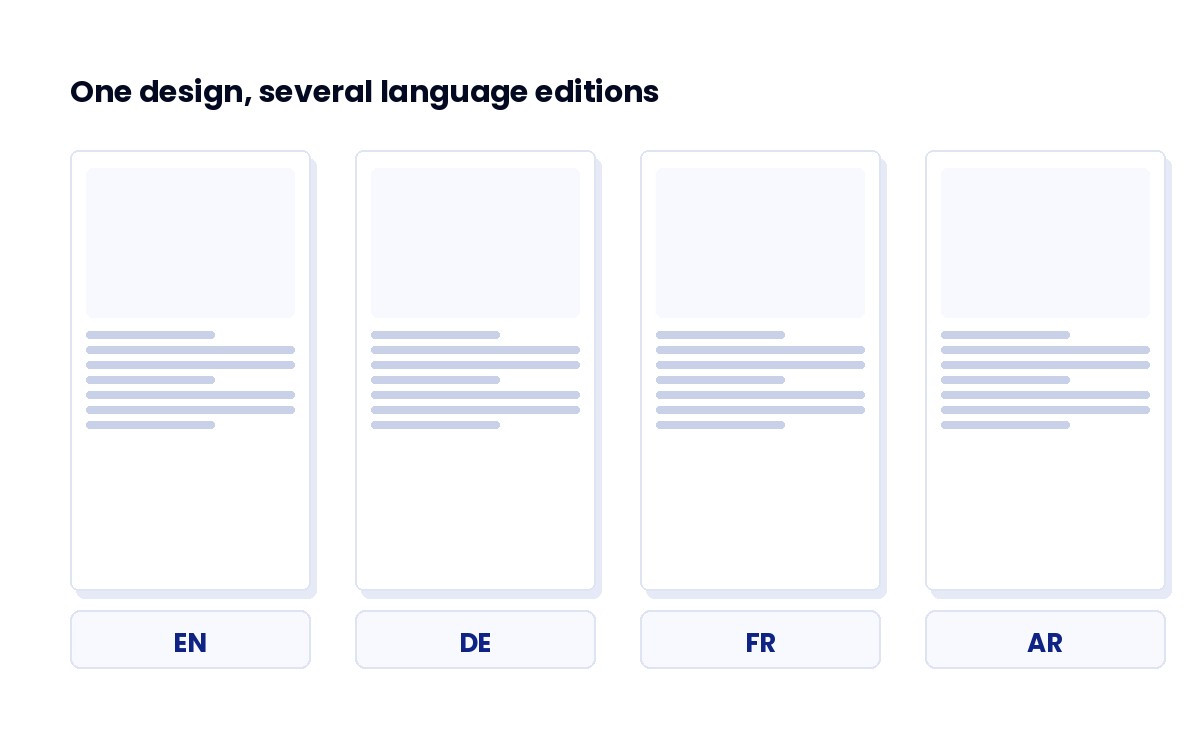
Several Language Editions From One Catalog
If you export or sell in more than one country, the same catalog can be produced as separate language editions. Your current file stays as it is, and English, German, French, Arabic, Spanish or any other required edition is built alongside it.
That work is not a find-and-replace. Text length changes with every language. An English heading that fits on two lines can run to three in Turkish. German compounds push column widths. Arabic reads right to left and the page structure has to be reconsidered. So headings, descriptions, tables, line spacing and text frames are all reset for the target language.
The goal is a file that does not read like a translation. It should look like it was designed in that language from the beginning.
If the published editions also have to work with a screen reader: multilingual PDF accessibility.
No Source File? We Can Still Work
This is the single most common situation I run into. The source file is gone. The catalog was produced years ago at another agency, the designer is unreachable, and all that survives is the PDF you send to customers. Sometimes not even that — just JPEG pages or a scan.
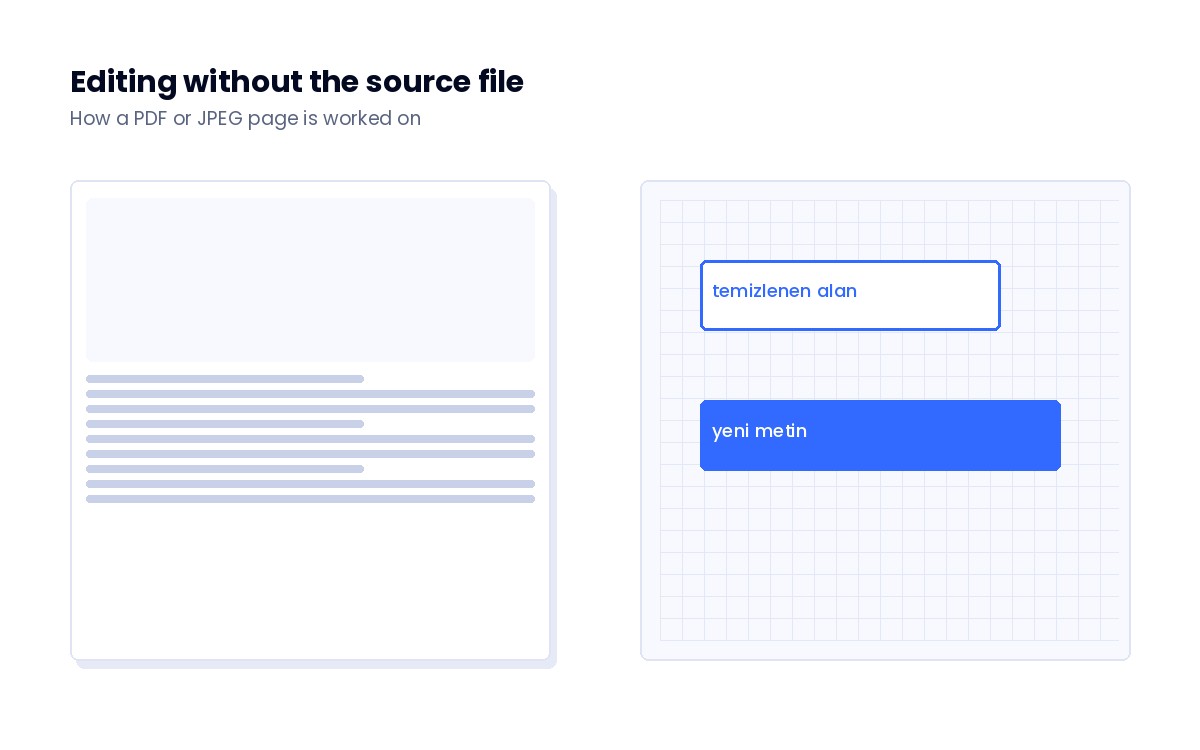
Work is still possible without an AI, PSD, INDD or CDR file. The method changes: the area being replaced is cleaned out, the background is rebuilt, a close match to the original typography is set up, and the new text is applied so it sits naturally on the page. My Photoshop background is what makes this workable.
I will not promise the same result on every file, though. A low-resolution, heavily compressed or poorly scanned page has a ceiling. That is why I check the technical structure and resolution first. Which areas can be edited directly and which have to be rebuilt is clear before any work starts.
File Types I Work With
PDF catalogs, JPEG and PNG catalog pages, product catalogs, corporate brochures, product sheets, technical documents, price lists, sales presentations and print-ready legacy catalogs. If your file is not on that list, send it anyway — I will look at it and tell you plainly what can be done.
Catalog Rebranding for Distributors and Dealers
This is where the service earns its keep. A catalog from an overseas manufacturer carries the manufacturer’s logo, address and contact details. The local distributor wants to hand the same catalog to customers with their own details on it.
The catalog does not need rebuilding. The manufacturer’s core design stays, distributor details go in, contact blocks are replaced, unwanted language sections come out, and the document is rebuilt in the target language.
Sometimes that is a few pages. Sometimes it is a technical catalog with hundreds of products. On long documents, fixing pages one by one is not enough: product codes have to stay matched to the right products, every repeated footer needs to be caught, and consistency across pages is checked separately.
Before and After Editing
The diagram below shows what typically changes in a catalogue revision. On the left is the page as it reaches me; on the right, the same page after editing. Seven points of intervention are marked with the same number on both sides: the layout, the typeface and the colour stay exactly as they were, and only the content is updated.
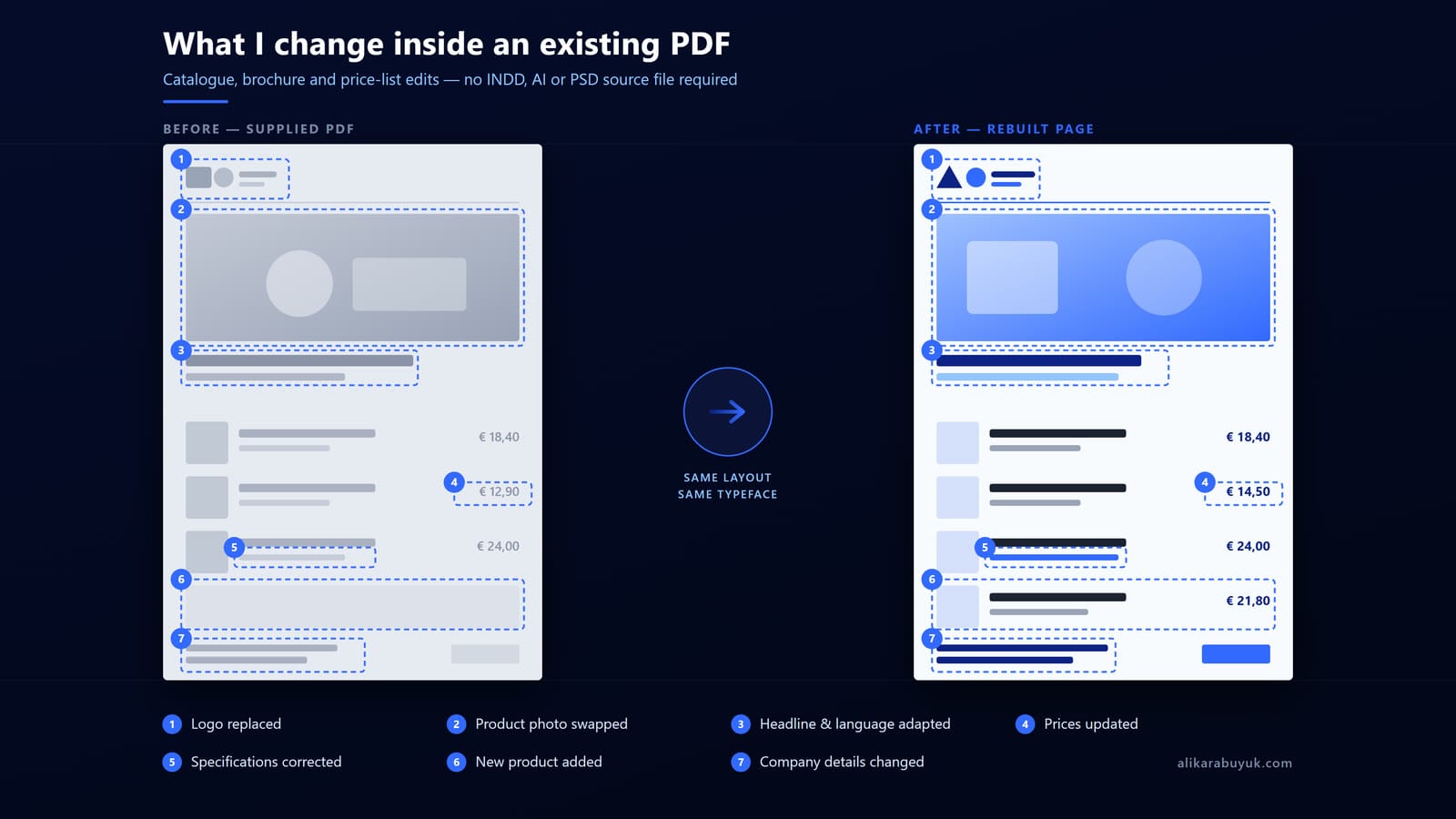
The Seven Changes in the Diagram
Notice that only one of the three prices changes in the diagram; the other two stay as they were. That is how the real work goes too: the catalogue is not re-typeset from scratch, only the parts that need to change are touched. Everything else stays exactly as it was in the original file.
This is an explanatory diagram, not a real client project. Client catalogues, price lists and product data are never shared anywhere, which is precisely why the diagram is drawn with placeholder content.
The Original Design Is Preserved Wherever Possible
This is the part that matters most in a catalog revision. Most clients are not asking for a new design. They have a catalog they like, one they have used for years or one the manufacturer produced properly, and all they want is different content inside it.
So I do not make cosmetic changes for their own sake. Colours, visual language, page structure and overall composition stay as close to the original as possible. When new copy will not fit the existing space, small typographic and layout adjustments are needed — usually point size, leading and text frame width. If the font used in the source file is not commercially available, the closest match in character structure is used instead.
The aim is not a file that looks tampered with. It should look like the new information belonged there all along.
Who This Is For
Anyone whose documents need updating on a regular basis. It is not restricted to large companies either — scope ranges from changing a few pages inside a PDF to rebuilding a several-hundred-page product catalog.
How It Works
Print Preparation
If the catalog is going to press, say so at the start. Print files handle resolution, colour profile and bleed differently from digital ones. If the source material is good enough, the work can be prepared for print. If it is not, I will tell you that too.
Frequently Asked Questions
Let’s Get Your Catalog Back Into Use
If you have a catalog sitting unused because it went out of date, a full redesign may not be what you need. It might be a product catalog you cannot send out because it is in the wrong language, a PDF still carrying your old logo, or a long document waiting on new products. Send the file and let’s see what it actually needs first.
You can also browse my portfolio or get in touch through the contact page.