
Easy-to-read information
Easy Read and plain language versions of official and business texts
Easy Read and plain language versions say the same thing as an official text, in words their readers can follow: one statement per sentence, active verbs, hard words explained the first time they appear, and the reader addressed as “you”. I rewrite legal notices, privacy notices, letters, forms and guidance into English Easy Read or plain language, German Leichte Sprache or Einfache Sprache, and Turkish kolay okunur metin. You receive accessible HTML, Word and tagged PDF files, a measured readability report, and a plain list of what the measurements cannot tell you.
In short
What I do
- Rewrite official and business texts into Easy Read or plain language in English, Leichte Sprache or Einfache Sprache in German, and kolay okunur metin or sade dil in Turkish.
- Write each language from the meaning of the source, not as a translation of another easy version.
- Add a short word list that explains the hard terms the text cannot avoid.
- Deliver the text as accessible HTML, Word (.docx) and tagged PDF, checked with axe-core and the Nu Html Checker.
- Measure the source and the easy version with the readability formulas of each language, and count the rules (sentence length, passive, negation, numbers) before and after.
Not part of this service
- A test group check. I do not have a test group. If you arrange and pay for a test group partner, I build their check into the schedule and revise the text after their feedback.
- The Leichte Sprache or Inclusion Europe logo. A text may carry these only after a check by its readers. Without that check, the files say “draft, not checked”.
- Legal review. An easy version explains a text; it does not replace it. You or your lawyer check that the legal meaning is still right.
- Pictogram systems. The example uses decorative icons only, no licensed symbol system such as METACOM.
- Sign language and audio versions.
Is this page for you?
This page is for you if one of these describes your situation:
- You work for a public body, council or agency, and letters, forms or web pages have to be understood by everyone, including people with learning disabilities.
- You publish privacy notices, terms or consent texts that the law expects to be clear, and the current version reads like a statute.
- You are a bank, insurer, hospital or utility whose customer letters cause calls, complaints or mistakes because people do not understand them.
- You serve German-speaking or Turkish-speaking readers as well, and want the three versions to say the same thing.
Check one of your texts in one minute
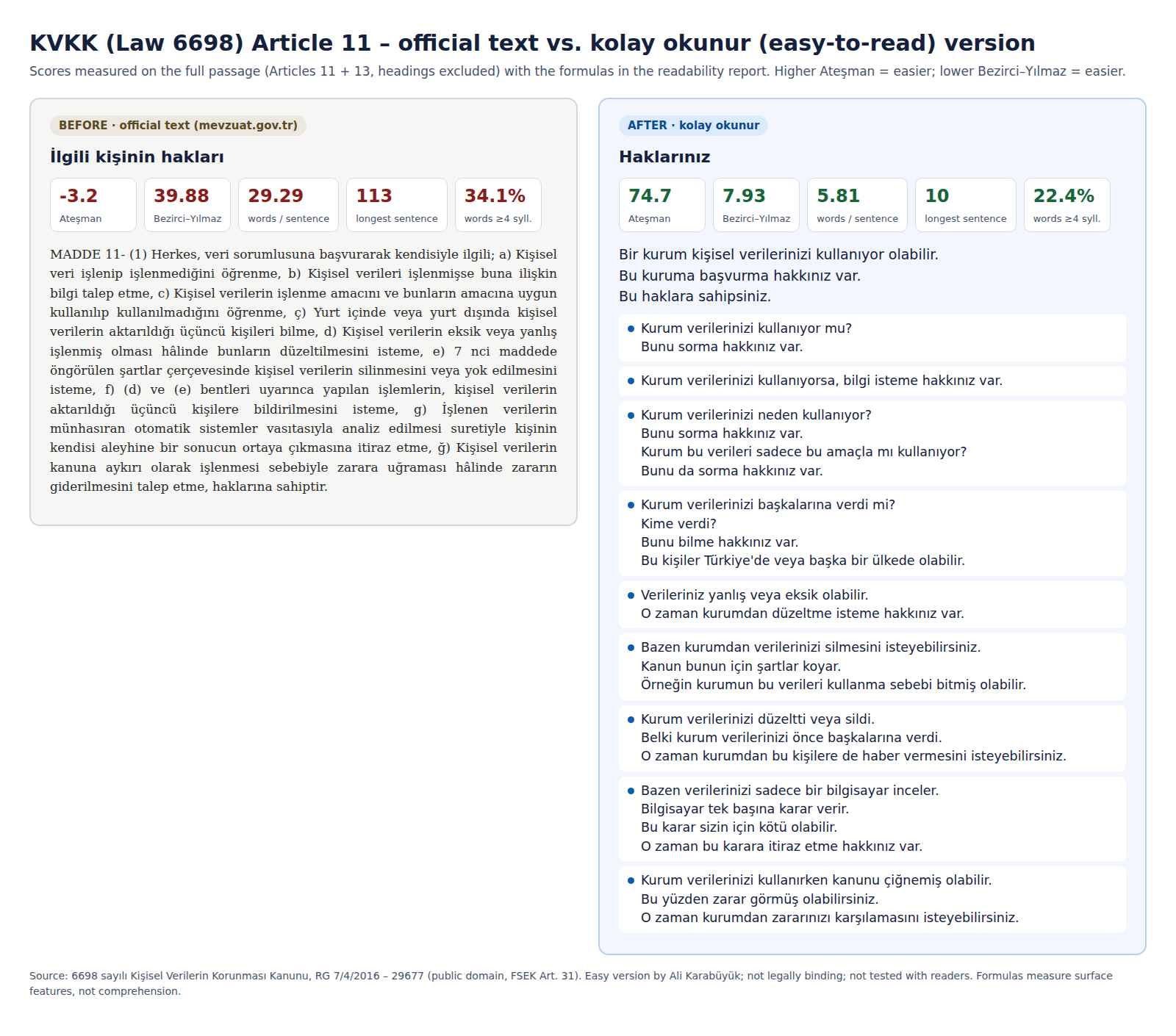
- Longest sentence: find it and count the words. Easy Read sentences in the worked example below have 13 words at most; the official passage had one with 113.
- Who acts: mark every sentence where you cannot tell who does something (“the request shall be processed”).
- Hard words: underline the terms a 12-year-old would not know. Is each one explained where it first appears?
- The reader: count how often the text says “you”. In the example source, no sentence did.
If most of these fail, a readability formula will confirm it; the worked example shows what the formulas cannot see.
Read on for the technical detail. Below: what separates Easy Read from plain language, a measured before-and-after example on two articles of Turkish data protection law in three languages, with every file downloadable, and the rules that ask for easy-to-read information. To skip ahead, send one text and I will tell you what makes it hard to read.
Easy Read and plain language: what the terms mean
Easy Read is written for people with learning disabilities and follows strict rules; plain language is clear writing for the general public. Both keep the meaning of the original; they differ in how far they simplify.
Easy Read and Leichte Sprache
Easy Read in English and Leichte Sprache in German are the strictest level. Each sentence carries one statement and starts on a new line. The text uses common words and explains the unavoidable ones, prefers active verbs, avoids negation, and writes numbers as digits. German Leichte Sprache also splits long compound words with a middle dot (Daten·schutz·amt) and avoids the genitive. The rules come from Inclusion Europe (“Information for all”, 2009) and from the Netzwerk Leichte Sprache; DIN SPEC 33429:2023 gives recommendations for German Leichte Sprache.
Plain language and Einfache Sprache
Plain language, and in German Einfache Sprache, is one step closer to standard language. Sentences can be longer, and the layout is a normal document. It is written for busy adults, people reading in a second language and anyone who meets the subject for the first time. ISO 24495-1:2023 sets out the governing principles. Which level fits depends on who has to understand the text; for some texts you need both.
Turkish: kolay okunur metin and sade dil
Turkish has no fixed rule set comparable to Leichte Sprache. I apply the same rules to Turkish and measure the result with the two Turkish readability formulas, Ateşman (1997) and Bezirci–Yılmaz (2010).
What readability formulas measure
Formulas such as Flesch Reading Ease, Flesch-Amstad or Ateşman count sentence length and syllables. They are useful to show change, but they do not measure understanding: a short sentence can still be unclear. In the report I always show them next to the rule counts and say which detectors are heuristics.
Evidence: two articles of a data protection law, in three languages
This is a measured worked example on a public-domain legal text, not client work. I rewrote two articles of the Turkish Personal Data Protection Law into Turkish kolay okunur metin, English Easy Read and German Leichte Sprache, built HTML, Word and PDF files, and measured everything before and after. All files and reports can be downloaded below.
Source and license
- Text: Law No. 6698 on the Protection of Personal Data (KVKK), Article 11 “Rights of the data subject” and Article 13 “Application to the data controller”, Official Gazette of 7 April 2016, No. 29677.
- Source: the official legislation portal mevzuat.gov.tr, retrieved on 6 October 2026. The text used is word for word the text retrieved; Articles 11 and 13 carry no amendment notes.
- License: laws are not protected by copyright in Turkey (Law No. 5846, FSEK, Article 31).
- English and German “before” texts: my own faithful standard-language translations, made only as a measurement baseline. They are not official translations, so the English and German “before” scores depend on my translation style.
The three easy versions were each written from the meaning of the Turkish source. The German was not translated from the English.
Readability, measured before and after
Measured on the body text, headings and the source note excluded, with one sentence splitter for all six texts. Each formula applies to its own language only.
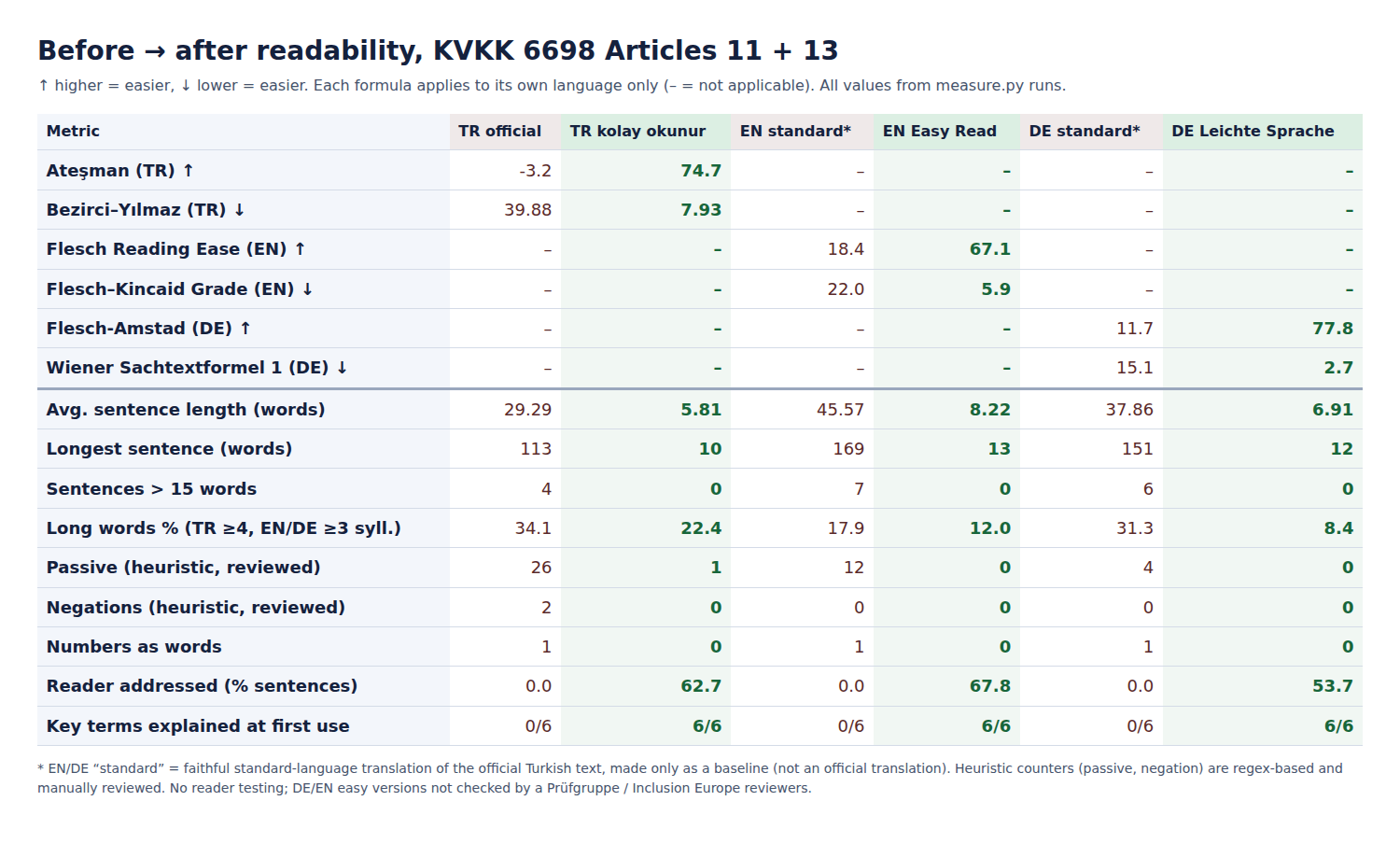
| Measured | Turkish official | Turkish easy | English standard | English Easy Read | German standard | German Leichte Sprache |
|---|---|---|---|---|---|---|
| Main formula (higher = easier) | Ateşman −3.2 | 74.7 | Flesch Reading Ease 18.4 | 67.1 | Flesch-Amstad 11.7 | 77.8 |
| Grade formula (lower = easier) | Bezirci–Yılmaz 39.88 | 7.93 | Flesch–Kincaid 22.0 | 5.9 | Wiener Sachtextformel 1: 15.1 | 2.7 |
| Sentences / words | 7 / 205 | 59 / 343 | 7 / 319 | 59 / 485 | 7 / 265 | 67 / 463 |
| Average sentence length (words) | 29.29 | 5.81 | 45.57 | 8.22 | 37.86 | 6.91 |
| Longest sentence (words) | 113 | 10 | 169 | 13 | 151 | 12 |
| Sentences over 15 words | 4 | 0 | 7 | 0 | 6 | 0 |
| Long words (Turkish ≥ 4 syllables, others ≥ 3) | 34.1 % | 22.4 % | 17.9 % | 12.0 % | 31.3 % | 8.4 % |
The text got longer: 205 Turkish words became 343. Easy-to-read texts usually do, because they explain what the original assumes. A cross-check with the textstat library (version 0.7.13), which splits sentences differently, gave values within 1.5 points of mine.
What the bands mean, as published by the formula authors: Ateşman 70–89 is “easy”; Flesch Reading Ease 60–70 is “plain English”; a Flesch–Kincaid grade of 5.9 is about US grade 6; Amstad 70–80 is “fairly easy”. The Turkish easy text still has 22.4 % words of four or more syllables. Turkish builds words by adding suffixes (verilerinizi, “your data”, has six syllables), and syllable formulas penalise this even when the word is common.
The writing rules, counted
| Rule | Turkish | English | German |
|---|---|---|---|
| Passive constructions (after review) | 26 → 1 | 12 → 0 | 4 → 0 |
| Negations (after review) | 2 → 0 | 0 → 0 | 0 → 0 |
| Genitive links | – | – | 12 → 0 |
| Words of 13+ letters not split | – | – | 16 → 3 |
| 6 key terms explained at first use | 0/6 → 6/6 | 0/6 → 6/6 | 0/6 → 6/6 |
| Numbers written as words | 1 → 0 | 1 → 0 | 1 → 0 |
| Sentences addressing the reader | 0.0 % → 62.7 % | 0.0 % → 67.8 % | 0.0 % → 53.7 % |
The one remaining Turkish “passive” is okunur in the fixed term “kolay okunur”. The three unsplit German words (Verantwortlicher and Widersprechen twice) are not compounds and were left whole on purpose. The six key terms are personal data, data controller, the Board, to apply, to delete and to object.
What the output checks report
| Check | Result (Turkish / English / German) |
|---|---|
| axe-core 4.13.0, WCAG 2.0–2.2 A/AA and best practice | 0 violations, 0 incomplete, 34 rules passed in each HTML file |
| Nu Html Checker | 0 errors in all HTML files |
| Language declared | tr / en / de in HTML; tr-TR / en-GB / de-DE in PDF and Word |
| Type and spacing | 14 pt in print, line spacing 1.5, left aligned, no automatic hyphenation |
| Sentences wrapping to a second line (screen and A4) | 2 of 59 / 4 of 59 / 3 of 67; none longer than two lines |
| Tagged PDF structure | 1 H1, 5 H2, 2 lists, 17 list items; 63 / 63 / 71 paragraphs; 4 / 4 / 5 A4 pages, fonts embedded |
| PDF/UA validation | not done |
What the checks do not report
Whether readers understand it
No test readers checked these texts. A Leichte Sprache text has to be checked by a Prüfgruppe of people with learning difficulties before it may carry the Leichte Sprache logo; Easy Read needs checking by people with intellectual disabilities before it may use the Inclusion Europe logo. Neither was done, and every file says so. The German file is marked “Entwurf, nicht geprüft” (draft, not checked).
Whether the legal meaning survived
The easy versions are not legally binding, and each says so in its own text. Some detail is simplified: “deletion or destruction” became one “delete”, and the reference to Article 7 became an example. The text owner or a lawyer checks this.
Whether a formula fits the text
The Turkish formulas were calibrated on school texts; using them on adult public information is an approximation. German syllables come from hyphenation patterns, which are approximate for compounds.
Style, passives and negation
Those counters are pattern searches. They miss cases and flag wrong ones; I reviewed every match by hand, and the removed false positives are listed in the report.
axe-core tests only part of WCAG and says nothing about language quality. The PDFs come from Chromium; the word list is tagged as non-structural rather than as a list, the PDFs were not validated against PDF/UA or read with a screen reader, and the Word files were not run through Word’s own Accessibility Checker.
Download the files and compare
| File | What it is | Size |
|---|---|---|
| Worked example (ZIP) | All files below, plus the source text and English/German baselines (TXT), the three HTML versions, the readability report (HTML and JSON) and the measurement scripts | 859 KB |
| English Easy Read (PDF) | Tagged PDF, 4 pages, not tested with readers | 103 KB |
| English Easy Read (Word) | Editable .docx, 14 pt, line spacing 1.5 | 38 KB |
| German Leichte Sprache (PDF) | Tagged PDF, 5 pages, draft, not checked by a Prüfgruppe | 109 KB |
| Turkish kolay okunur (PDF) | Tagged PDF, 4 pages | 103 KB |
| Score table (PNG) | All readability and rule counts in one table | 161 KB |
What you receive
You receive the easy-to-read text in the formats you publish, with a report that shows what changed and what still needs a human check.
- The easy-to-read or plain language version in each language you order, with a word list for the hard terms.
- Accessible HTML, an editable Word file and a tagged PDF, with the language set and the layout rules applied.
- A readability report: formulas and rule counts before and after, and every heuristic match I removed by hand.
- A list of every place where I simplified a legal or technical detail, so that you or your lawyer can check it.
- Files marked “draft, not checked” until a test group has checked them, if you arrange one.
How the work runs
You send one real text first; the price is fixed before any work starts.
- Send one text. The letter, notice or form that causes the most questions. I tell you which level fits (Easy Read or plain language) and what makes it hard.
- You receive a scope and a fixed price for that text or the whole set, in the languages you need.
- I do the work. You receive a preview version, marked as such, with the readability report and the list of simplified details for your review.
- Your approval releases the final files. If you have a test group partner, their feedback comes before this step, and I revise the text once more.
Pricing
I price each job after seeing the text. Word count alone does not decide the effort: a short legal clause can need more work than a long information leaflet, because every simplification has to be checked against the meaning. You get a fixed price for the set before work starts, with no hourly meter. If you need more than one language, the quote shows each language separately.
Why this matters now
German federal bodies must offer key information in Leichte Sprache on their websites, and privacy laws expect notices people can understand. What that means for your organisation is a legal question; this page covers the writing side.
- Germany, federal websites: § 4 BITV 2.0 requires the start page of a public body’s website to give, in German Sign Language and in Leichte Sprache, information on the main content, navigation hints, the main points of the accessibility statement, and pointers to other content in Leichte Sprache.
- Germany, official decisions: under § 11 BGG, federal authorities should, on request, explain notices, general rulings, public-law contracts and forms to people with intellectual or psychosocial disabilities in simple language, and in Leichte Sprache if that is not enough. They should also provide more information in Leichte Sprache.
- Turkey, privacy notices: the KVKK communiqué on the duty to inform (Official Gazette 10 March 2018, No. 30356), Article 5(1)(ğ), requires the notice to the data subject to use understandable, clear and plain language.
- United States: the Plain Writing Act of 2010 requires federal agencies to use plain writing in the documents it covers.
- The standard: ISO 24495-1:2023, Plain language, Part 1: governing principles and guidelines.
Legal note: this page covers the technical side. Whether a rule applies to you, and whether an easy version meets it, is for your legal adviser to confirm.
Frequently asked questions
What is the difference between Easy Read and plain language?
Easy Read is written for people with learning disabilities: one statement per sentence, each sentence on its own line, hard words explained. Plain language is clear writing for the general public and stays closer to standard text. In German the two levels are Leichte Sprache and Einfache Sprache.
Can the text carry the Easy Read or Leichte Sprache logo?
Only after people from the target group have checked it. I do not run such a test group. If you arrange and pay for one, I plan their check into the work and revise the text after it; until then the files say they are a draft, not checked.
Is the easy version legally binding?
No. It explains the official text and says so in its own words. Where I simplify a legal detail, I list it, and you or your lawyer check that the meaning is still right.
Is a good readability score enough?
No. Formulas count sentence and word length; they do not measure understanding. I report them next to rule counts and list what they cannot see, as in the worked example.
Do you translate between languages as well?
I write each easy version from the meaning of the source, in English, German or Turkish. In the worked example the German was written from the Turkish law, not translated from the English version.
Which formats do you deliver?
Accessible HTML, an editable Word file and a tagged PDF, each with the language set, 14 pt type in print, line spacing 1.5 and left alignment. Other formats can be agreed in the scope.
Related services
Send me one text
One text — the letter, notice or form your readers struggle with most. You get back a straight account of what makes it hard to read, and which level of easy language fits it.
Ali Karabüyük · Tekirdağ, Türkiye · working remotely with clients worldwide · document and image production since 2004, professional practice since 2008.