
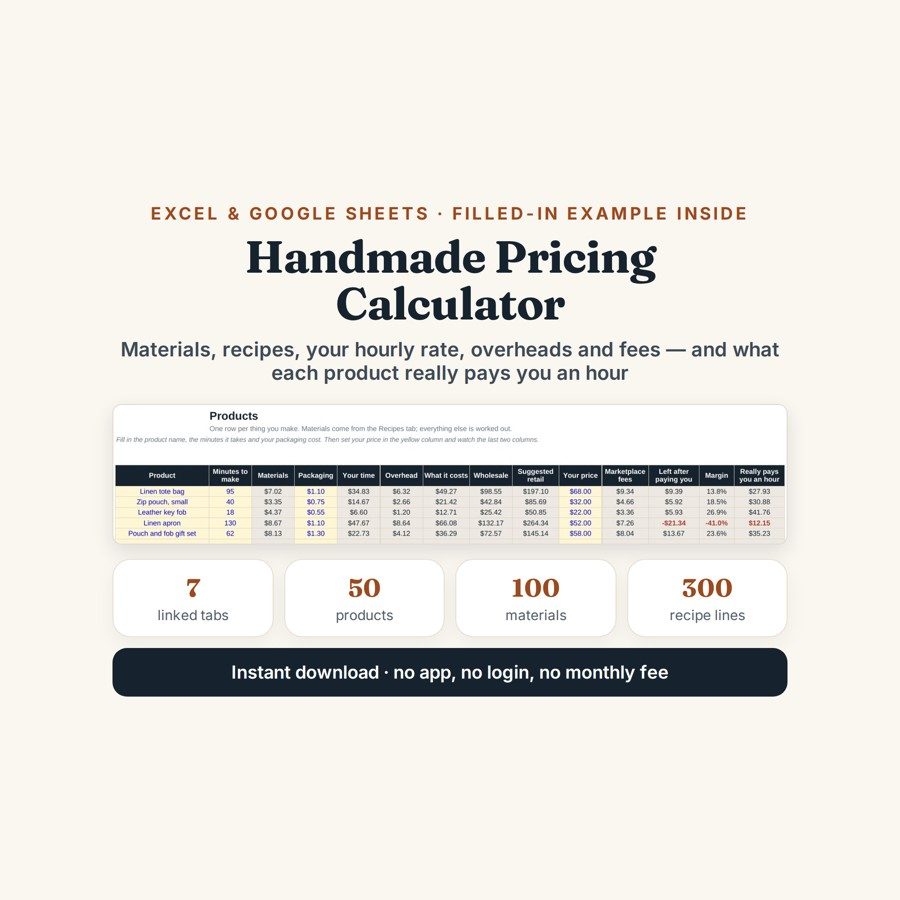
Handmade Pricing Calculator
This handmade pricing calculator costs every material, pays your own hour at a rate you set, spreads a year of overheads across your real making hours, and takes the marketplace’s cut off the end.
Most handmade pricing is materials plus a guess, and the guess is where the wage goes missing. It is how a maker can work a full week, sell everything on the table, and end up with nothing to show for it.
What is in it
- Seven tabs: Start Here, Setup, Materials, Recipes, Products, Fee Check and Price List.
- Setup — your own hourly rate, a year of overheads, your marketplace fees and your wholesale and retail multipliers, all in one place.
- Materials — 100 rows, costed to four decimal places, so 0.9 metres of linen costs what 0.9 metres of linen costs rather than being rounded into a guess.
- Recipes — 300 lines. What actually goes into each product: the linen, the zip, the label, the box.
- Products — 50 rows, each showing true cost, wholesale price and retail price worked out from the same set of figures.
- Fee Check — listing fee, transaction percentage, payment processing and its fixed part, and the advertising rate you really average, all typed by you and taken off a sale down to the profit left; plus a Price List tab laid out to send a retailer.
Who it is for
Makers selling handmade goods on Etsy, at craft fairs and markets, and into wholesale. It is for the point where you are busy enough that guessing has become expensive: several products, shared materials, and a bench that has to pay for itself. It prices what you make; it does not sell it, and it does not care which marketplace you are on because you type your own fees in.
The worked example
The file arrives filled in with eight materials, five products and twenty-eight recipe lines. One of the five loses money on every sale — deliberately, because a pricing file that only shows you winners is not doing its job.
The apron is the one that stings: it pays $12.15 an hour against a $22 target and loses $21.34 a sale once materials, your hour, overheads and the marketplace’s cut are all counted. The key fob, which nobody thinks about, pays $41.76 an hour. Same maker, same bench, same week — and nothing on either listing page would have told you which was which.
How it works
Compatible with Microsoft Excel 2016 or newer on Windows or Mac, Google Sheets, and LibreOffice. No macros, no add-ons, no account to create, nothing to install.
The download has two workbooks: one with the example above already filled in, so you can see what every column expects, and the same file completely blank for your own figures. A plain-English guide comes as a PDF. Order on WhatsApp — $9
Orders are taken on WhatsApp: message me and I’ll send the payment details, then the files as soon as the payment is confirmed.
Questions people actually ask
How do I know if I am charging enough for something handmade?
Enter the materials, the minutes it takes you and your target hourly rate, and the Products tab shows what the piece actually pays you per hour at your current price. In the worked example an apron pays $12.15 an hour against a $22 target and loses $21.34 a sale, while a key fob pays $41.76. Overheads and marketplace fees are taken off before those figures, so they are what is left rather than what is charged.
Does it work for Etsy sellers and market traders both?
Yes — you type your own fee structure into Fee Check, so it fits any marketplace or none. Listing fee, transaction percentage, payment processing and its fixed part, and the advertising rate you really average are all yours to set. A market stall with no platform fees simply leaves those cells at zero, and the wholesale and retail prices still come from the same figures.
I do not know what my overheads are. Can I still use it?
Yes — put in the costs you do know for a year and Setup spreads them across your real making hours rather than across a guess. Anything you leave out understates the cost, but the file still works and you can add to it later. Setting the recipes up takes about an hour the first time; after that a new product is a few lines.
Will it work in Google Sheets and in my own currency?
Yes on both — it is built as .xlsx, opens in Google Sheets and LibreOffice as well as Excel 2016 or newer, and it carries no currency of its own, so the figures are whatever you type. For Google Sheets use File, then Import, then Upload, and choose Replace spreadsheet. No macros and nothing to install.
Does it track my stock or my orders?
No — it is a pricing file only, and it does nothing else on purpose. There is no stock count, no order list and no sales record in it, and it connects to no shop, bank or payment account. Wholesale prices come from a multiplier you set rather than from a pricing strategy, so the judgement about what the market will bear stays with you.
Need it built around your business?
This file assumes you make the products yourself, price from materials and your own hours, and sell through a marketplace or into wholesale. If your making runs differently — batch production where the unit cost falls with volume, outworkers paid per piece, kits and made-to-order commissions priced individually, or several shops with different fee structures — I can rebuild the same arithmetic around the way you actually make and sell.
All other templates are listed on the Excel & Google Sheets Templates page.